We independently review each item we recommend and appreciate your trust and support. When you buy through our links, we may earn a commission.Learn more.
Sennheiser All-Day Clear is in the Top 10% of all products tested.
The Sennheiser All-Day Clear Hearing Aid, priced at $949.95 per pair, offers rechargeable, FDA-approved OTC hearing aids designed for mild to moderate hearing loss. Featuring hands-free calling, Bluetooth streaming for both iPhone and Android, and intelligent scene detection for optimal sound quality, these devices provide a user-friendly and high-quality hearing solution.
The All-Day Clear over-the-counter (OTC) hearing aid from Sennheiser performed exceptionally well in both HearAdvisor lab testing and HearingTracker real-world trials; in fact, at this writing, it is in first place for HearingTracker scoring in the OTC category. In acoustic testing at the HearAdvisor lab, this receiver-in-canal (RIC) device scored 4.2 (out of 5), earning it an A SoundGrade and the lab’s Expert Choice Award. HearingTracker real-world testing yielded a score of 4.5/5, with high marks for its design, comfort, Bluetooth wireless streaming, ease of use, app features, build quality, and support. Its 20-hour battery life places it on the “average” to “just-below-average” side compared to all devices.
However, even with all these high scores, there are some things about this hearing aid that we didn’t like, including its reliance on speech samples rather than an audiogram for fine-tuning, the charging case, and some other relatively minor aspects we’ll note below.
Our quick take: Sennheiser All-Day Clear is a very solid OTC hearing aid. We also like the option to get help with the device from a licensed professional, albeit for an added charge. However, we’ll note that its $800-$1,000 price tag (without this service) already positions it toward the higher end of the OTC hearing aid cost spectrum.
Pricing
Verified seller for Sennheiser All-Day Clear.
Sennheiser
Trusted Brand
Sennheiser is a globally trusted audio brand now offering direct-to-consumer, over-the-counter hearing aids designed for mild to moderate hearing loss. With self-fitting technology, Bluetooth connectivity, and optional in-clinic professional support, customers can access Sennheiser hearing solutions online with the flexibility to manage their care their own way.
Receiver-in-Canal (RIC) is a style of hearing aid in which the main processing unit sits behind the ear, and is connected by a wire to a receiver (speaker) that sits inside the ear canal (hence the name). Generally speaking, RICs have many advantages because they’re small enough to be cosmetically appealing while large enough to house important features like directional microphones, sensors, Bluetooth wireless, and larger batteries. RICs are now the most common style of hearing aid in the United States, accounting for about 80% of prescription hearing aids.
In general, receiver in canal style “open fit” hearing aids like All-Day Clear allow external sounds to be mixed with the amplified or processed sounds. This can be advantageous because they tend to mitigate the occlusion or “own voice” effect—a common complaint among hearing aid users—and provide you with a more “natural” sounding experience in many conversation settings.
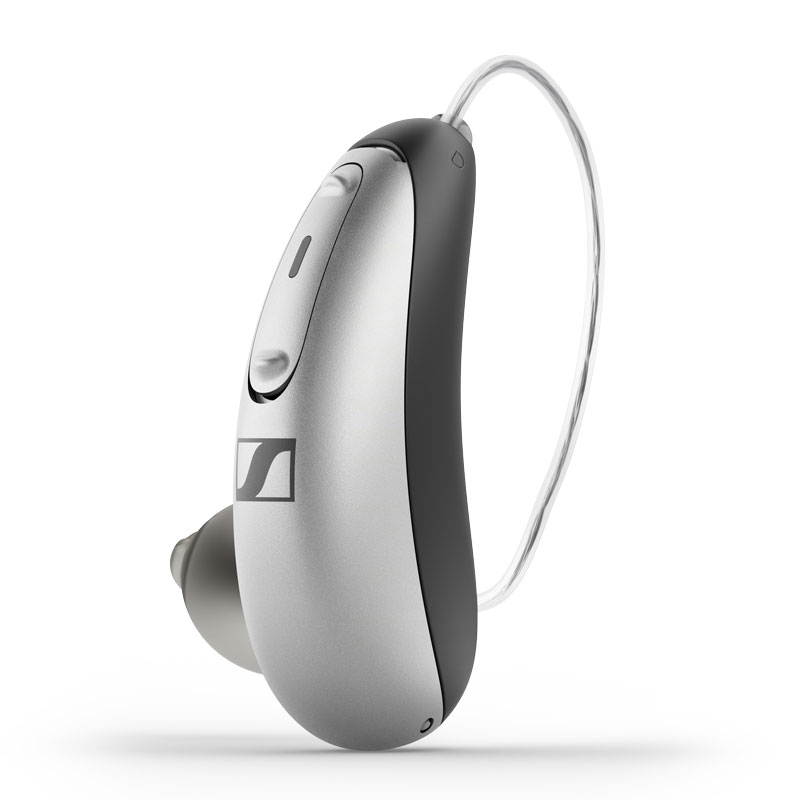
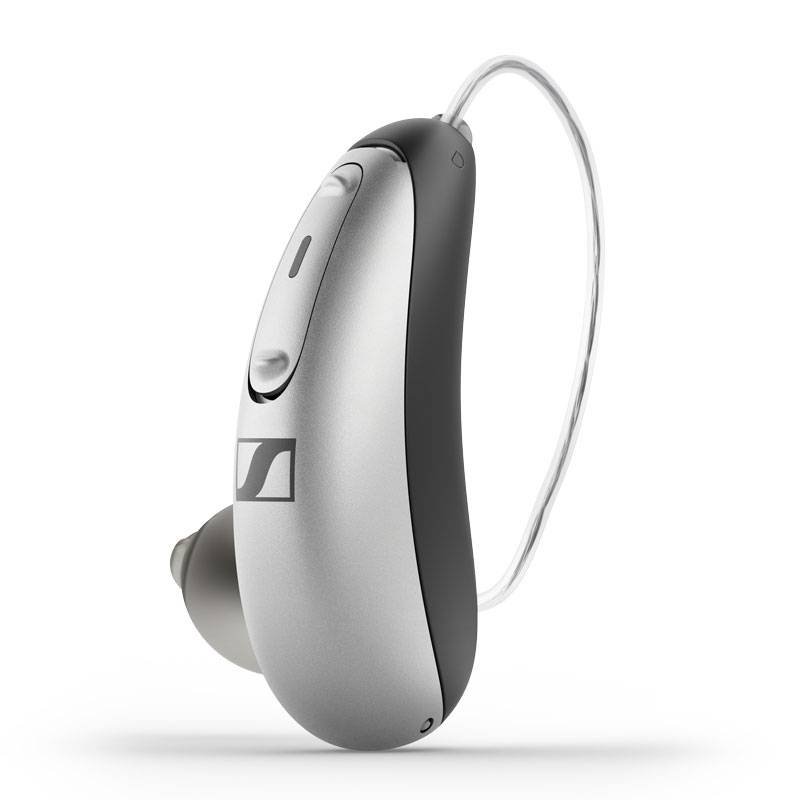
Sennheiser All-Day Clear OTC hearing aids in my palm. The devices are average-size receiver-in-canal (RIC) hearing aids.
What Is Sennheiser All-Day Clear?
Sennheiser All-Day Clear falls into a unique category: loosely speaking, it’s a professional-grade prescription hearing aid redesigned for the OTC hearing aid market. That generally means we should expect good performance, but we’ll break its performance down below based on my hands-on, objective lab testing.
So, if you’re an audiophile, audio engineer, or musician, you’re probably familiar with the Sennheiser brand, which has traditionally been known for its line of audio equipment. But when did they start making hearing aids?
Back in 2022, Sonova—the largest hearing aid manufacturer in the world, which also manufactures Phonak and Unitron hearing aids— acquired the Sennheiser consumer division. Think of it as a natural pairing between the worlds of hearing aids and consumer audio to develop better speech-enhancing earbuds and hearing aids.
There were initially two models of All-Day Clear: a traditional RIC and an elongated “Slim RIC” model, initially priced at $1400 and $1500 a pair, respectively. However, the company has since narrowed its offering to the traditional RIC and reduced the price to $995.95 per pair—but we’ve frequently seen All-Day Clear on sale at the Sennheiser and other retail websites for as low as $799.95.
You can purchase these hearing aids directly from the Sennheiser website or Big Box retailers, such as Best Buy, Amazon, Walmart, and Target. They are also available through Sonova’s AudioNova hearing clinic network, as well as the United Healthcare website for some of its members. Make sure to shop around, as prices between the websites can vary. As we’ll discuss later, All-Day Clear can also be fit like a prescription hearing aid in-office, which changes a few important things, so keep reading…
This is an OTC hearing aid, meaning it is intended for those with no worse than mild-to-moderate hearing loss. If you’re not sure what level of hearing loss you have, we strongly recommend visiting a hearing care professional for a comprehensive hearing exam and audiogram, or at least taking a good online hearing test to get an approximation of your hearing loss level. Sennheiser also offers its own 3-minute hearing screener.
Before we go any further, here are some key product specs for Sennheiser All-Day Clear. You’ll notice that the features are fairly modern, with great wireless performance and all-day battery life, which ties back to Sennheiser’s connection to a major hearing aid manufacturer.
How the Sennheiser All-Day Clear OTC hearing aids look on my ears.
Key All-Day Clear Product Specs:
Bluetooth streaming with hands-free calling, and active wireless connectivity with up to 2 devices
20-hour rechargeable battery life (dependent on individual usage, audio streaming, age of device, etc.)
Self-fitting customization with iOS and Android compatible All-Day Clear App
Two listening modes: Conversation in Quiet and Conversation in Noise
Directional microphones for better listening in noise
Onboard push-button controls for in-the-moment adjustments in addition to the All-Day Clear app
IP68 rating, the highest possible Ingress Protection from moisture and dirt/debris for hearing aids
No telecoil (t-coil) or Auracast broadcasting capabilities
Here's what you get inside the Sennheiser All-Day Clear package.
Unboxing and Details on Sennheiser All-Day Clear
Having provided a quick overview of the tech, let’s now take a look at what comes in the box and then we’ll dive into what it’s like to use Sennheiser All-Day Clear.
Inside, you’ll find the charging case with your pair of All-Day Clear hearing aids already inside. They come preloaded with a medium vented dome, and you do get a few additional size options to suit your ears, balancing comfort with retention.
On the back of each device, there’s a rocker switch, and these hearing aids communicate wirelessly—so any adjustment you make on one aid applies to both (a nice feature not available in all OTC devices).
In the lower compartment of the box, you’ll find a User Manual and a QR code to download the All-Day Clear app. You’ll also get a micro-USB cable and wall adapter.
You’ll also find some maintenance tools, including wax guards. If you’ve never changed wax guards before, it can feel a little intimidating, but it’s actually pretty simple. Start by removing the dome. At the end of the receiver, you’ll see a small white filter: that’s the wax guard, and it’s there to keep debris from clogging the speaker. Use the tool to pull the old one out, flip it around, and press the new one in.
You won’t need to do this often, but if your hearing aids suddenly sound weak or stop working, this is one of the first things to check before assuming something is seriously wrong. You’ll also get a small cleaning tool and a few extra dome sizes to ensure a good fit and comfort.
The charging case for Sennheiser All-Day clear is solid, but it is not pocket-sized and feels a bit behind the times for a few key reasons. First, there’s no internal battery, so you can’t charge your hearing aids on the go; the case has to be plugged in to charge the devices. Sennheiser now sells an optional All-Day Clear Power Pack for $149.95 that attaches to the bottom of the charging case and provides 2-3 full charges for the hearing aids. But, frankly, this is something many OTC hearing aids incorporate into their charging case designs.
Second, it uses micro-USB. Sennheiser includes the cable, which is good; however, if you forget it while traveling, there’s a decent chance you won’t have a backup lying around. Lastly, placing the hearing aids into the charger takes a little more effort than it should. Instead of a nice magnetic lock, it feels very mechanical, and it can be more difficult to seat and remove the hearing aids—not a huge deal, but if dexterity or hand strength is a concern, it’s worth keeping in mind.
Sennheiser now lists battery life at up to 24 hours on a single charge, depending on usage, rather than the 20 hours cited in earlier materials. A full recharge can take up to 3 hours. As my colleague Matthew Allsop shows in the video below, battery status can be checked in the All-Day Clear app, and the hearing aids’ indicator lights show approximate charge while in the charger: blinking red for under 10%, orange for 11-80%, and green for 81-99%; the light turns solid green when fully charged.
The charging case for Sennheiser All-Day Clear with the hearing aids inserted.
Sennheiser All-Day Clear Wireless Features
Sennheiser All-Day Clear OTC hearing aids are self-fitting hearing aids, which we’ll come back to in just a moment, but the key takeaway is that you must use the All-Day Clear app for setup and programming.
And honestly, that’s a good thing. Once you connect the devices to your iOS or Android device, you unlock Bluetooth streaming and sound customization. Pairing was straightforward in my testing. The app is compatible with Bluetooth-enabled smartphones and tablets running at least iOS 14 or Android 8.0 (note that the app works on tablets but isn’t optimized for them).
After you pair the devices with your phone or tablet, you’ll go through something called “My Sound Profile.” This is Sennheiser’s onboarding process, where you’ll listen to a speech sample and make a few simple choices around volume and clarity. This customizes All-Day Clear for your ears; however, it’s not as precise as an on-ear hearing assessment, direct input from an audiogram, or a professional fitting.
But this actually brings us to a unique aspect of All Day Clear: they can be professionally fit. The app has a clinic locator so you can contact a participating provider. Even though they’re marketed as a self-fit device, a hearing care professional can program them using special software, resulting in more precise adjustments, including multi-band tuning and feedback calibration.
I see many benefits to this hybrid approach to OTC hearing aids—not the least of which is confirming that OTC hearing aids like All-Day Clear are appropriate for you in the first place. The tradeoff, as you may guess, is cost. Fittings can run a couple of hundred dollars, depending on the provider, and this additional cost starts to close the gap between OTC and traditional prescription devices. But, in return, you should get better fine-tuning, additional support, and your warranty extends an additional year.
One of my concerns is if purchasers will be able to find professionals willing to help them with the device. That’s not a knock on providers; fitting All-Day Clear requires additional device knowledge, software, setup, and most providers are probably overworked to the point where these may pose a significant barrier. I’d be very interested in any comments from consumers who take this route.
Turning back to the app-based setup, once you’ve completed your sound profile, you’ll find standard controls like Volume and Program selection. There’s an additional “Fine Tune” section with a 3-band EQ for additional customization. You’ll also see a Wind Noise Reduction toggle; however, I’ll be honest: I didn’t notice much of a difference when using it. But to be fair, wind noise wasn’t a major issue during my testing anyway.
Sennheiser All-Day Clear app on the 3-band equalizer screen.
Sound modes are listed at the top of the app’s sound control screen. You can also change the volume and, as noted, activate the Wind Noise Reduction program. However, as Matthew points out in the video below, once the hearing aids are restarted, they will return to their default settings.
One small frustration with the app is its handling of connectivity. Every time I closed and reopened it, my hearing aids needed to reconnect. And even if I left the app open (e.g., for more than a minute or so), All-Day Clear would time out and disconnect on its own.
This is likely done to conserve battery life, but it does mean you’re waiting a second or two every time you want to make an adjustment. It’s not a deal-breaker, but, similar to the charger insertion and removal comment I made in the last section, it’s another point where I feel usability could be improved.
Sennheiser All-Day Clear is designed to be fully automatic, adjusting to different sound scenes as you encounter them. As noted earlier, in addition to the app, they also have onboard push-button controls for on/off, volume adjustment, sound mode selection, and phone call acceptance/rejection. Unlike some of Sonova’s advanced prescription hearing aids, this device has no tap controls.
Watch Audiologist Matthew Allsop’s Review of Sennheiser All-Day Clear
When All-Day Clear launched in 2023, my colleague, HearingTracker Audiologist Matthew Allsop, produced the video below that does a great job of describing the device. Note that, since that time, the OTC product has evolved, and the “Slim” version of the Sennheiser ADC is no longer available.
London-based audiologist and clinician Matthew Allsop provides an overview of Sennheiser All-Day Clear.
How Sennheiser All-Day Clear Performed in the HearAdvisor Lab
HearAdvisor is our independent testing lab, where we use standardized, research-based methods to evaluate hearing aid performance.
The goal is simple: measure how well these devices are likely to perform for typical age-related hearing loss—using the same protocol and in the same controlled acoustic environment for every hearing aid—prescription or OTC. That way, we can make fair, apples-to-apples comparisons.
HearAdvisor Scores
Overall, Sennheiser All-Day Clear received a HearAdvisor SoundScore of 4.2 out of 5 for an A SoundGrade, earning it a 2026 Expert Choice Award. Here are All-Day Clear’s results across HearAdvisor’s five sound quality metrics:
Test Condition
Initial Fit
Tuned Fit
Speech in Quiet
3.9 (+1.0)
4.0 (+0.7)
Speech in Noise
1.5 (+0.2)
1.6 (-0.1)
Feedback Handling
5.0 (+0.4)
5.0 (+0.7)
Own Voice
2.5 (-0.1)
2.5 (+0.2)
Music Streaming
3.4 (0.0)
3.3 (-0.1)
OVERALL SOUNDSCORE
4.2 (+0.6)
HearAdvisor lab scores (1 to 5, with 5 being best) for the five key acoustic tests performed in both the Initial Fit (out of the box following instructions or "first fit") and Tuned Fit (audiologist-optimized) conditions. Parentheses show comparison with the average of ALL hearing aids (OTC and prescription fit) tested by the HearAdvisor lab as of April 29, 2026.
Note that HearAdvisor concentrates its testing on what we believe are some of the “best” and “most popular” hearing aids available. As you can see from the table above, the HearAdvisor test scores for Sennheiser All-Day Clear are essentially as good as—and in many cases better than—the average for ALL 100+ hearing aids we’ve tested, which includes most of the best prescription hearing aids in the world. The overall weighted SoundScore of 4.2 for Sennheiser All-Day Clear places it in the top-15% of all OTC hearing aids and in the top-third of all the hearing aids we’ve tested to date.
When comparing it to other OTC hearing aids, the All-Day Clear demonstrated exceptional speech-in-quiet performance, scoring substantially above the OTC category average. Music streaming quality was also a standout, and feedback handling achieved a perfect 5.00 score in both fit conditions, indicating excellent stability without whistling during normal use. The device showed more modest performance in challenging listening environments; speech-in-noise scores measured only slightly above average, which may limit effectiveness in restaurants, group conversations, or other acoustically demanding situations.
At the bottom of this page, you can also listen to recordings of these hearing aids through our KEMAR lab-test manikin under different listeningconditions. You can also see detailed results at the HearAdvisor’s Sennheiser All-Day Clear summary page.
HearingTracker Scores
Acoustic testing in the lab, while extremely important, doesn’t tell the entire story of how the device performs in real life. That’s why we use a separate HearingTracker Score for other important real-world factors, such as battery life, wearing comfort, Bluetooth wireless connectivity, and design integrity. Here is what we found:
Test Condition
Score
Build quality
4.9
Battery
3.2
Bluetooth
5.0
App
4.5
Comfort
5.0
Design
5.0
Support
5.0
Handling
5.0
Value
4.5
HearAdvisor SoundScore
4.2
OVERALL HEARINGTRACKER SCORE
4.5
HearingTracker scores (1 to 5, with 5 being best) for real-world use of Sennheiser All-Day Clear.
The HearingTracker overall score of 4.5 places Sennheiser All-Day Clear at #1 among competing OTC hearing aids and #4 when including prescription hearing aids. It had perfect or near-perfect scores for build quality (IP68), wireless connectivity, comfort, design, support, and handling. Its battery life and recharging are average, and its value is very good, despite the $1000 price tag being higher than many competing OTC hearing aids. The All-Day Clear app is also highly rated, offering useful customizations such as volume control, programs, and a 3-Band EQ; however, it lacks more advanced features commonly found in other products, such as directional microphone controls and health tracking.
For many OTC hearing aids linked to a global hearing aid manufacturer like this one, it's often relatively easy to cite a model it closely represents. However, we couldn't really pinpoint the specific technology used in Sennheiser All-Day Clear. Without getting too deep into speculation, it does feel like you’re getting some of that Sonova DNA here—whether that’s Phonak or Unitron influence—packaged into an OTC format.
All-Day Clear allows for control of the devices via onboard push-buttons and/or the app to adjust settings.
Trial Period, Warranty, and Accessories
Sennheiser provides a 45-day risk-free trial, giving users time to assess their effectiveness and value. Should it not be right for you, make sure to return it within that time window for your refund.
All-Day Clear is IP68-rated, the highest moisture and dirt resistance rating that hearing aids can achieve, so, like most Sonova hearing aids, these are robust devices (still, we recommend you keep them out of the water). They come with a standard 1-year limited warranty. When checking out, you’ll also be offered 1, 2, and 3-year extended warranties for about $27, $54, and $82, respectively. If you click the “No Extended Coverage” option, it does not remove the standard 1-year limited warranty included with the hearing aids. (See warranty information for details on coverage.)
Sennheiser’s main All-Day Clear accessory is the TV Connector, sold separately for $349.95. It streams TV or stereo audio directly to the hearing aids and includes the TV Connector, Micro USB cable, wall plug, optical/TOSLINK audio cable, and analog 3.5 mm audio cable. Other spare parts include replacement eartips and wax guards, generally listed at $15.95.
Sennheiser TV connector.
Final Verdict
At the end of the day, Sennheiser All-Day Clear is a well-rounded OTC hearing aid delivering strong performance, modern features, and some flexibility. Here are my main "Pros and Cons" observations:
Positives
Strong Performance: All-Day Clear earned an A SoundGrade from HearAdvisor, which reflects overall strong objective sound quality performance. And in my own real-world testing, I’d say that holds up. These OTC hearing aids sound good and, quite honestly, are pretty consistent with what you’d expect from a prescription hearing aid adapted for the OTC market. All-Day Clear’s overall HearingTracker score is best-in-class.
Flexible Fitting: One thing I really like is that you have both self-fit and provider-fit options. This is a unique approach in the OTC realm. Again, it opens the door to basically prescription-level customization for your All Day Clear hearing aids. Professional guidance is almost always worth it, so long as it is feasible and affordable, so I do like this as an option.
Modern Features: From a feature standpoint, All-Day Clear checks many boxes. You’re getting all-day rechargeable battery life, app control, Bluetooth streaming, and more. At around $799, at least at the current sale price, it’s quite competitive.
Negatives
Basic Personalization: The “My Sound Profile” onboarding is…fine. But compared to some other OTC options, it feels a bit limited. You’re making adjustments based on a few speech-based preference questions, which is not as precise as a hearing test or audiogram. To Sennheiser’s credit, they do offer in-person support, which helps close that gap.
Basic Charging Case. The charging case feels behind the times. There is no standard internal battery for on-the-go charging, the hearing aids are locked-in mechanically, and they use micro-USB. It’s also larger than many other chargers. Overall, the charger design could use an update.
Price. At about $800 to $1000, this is still a significant investment. That doesn’t mean it’s a bad value, but based on my clinical experience, I can tell you that price point is still a barrier for a lot of people. And if you are considering the provider-fit approach discussed earlier, you will realistically add a few hundred dollars to the cost. As I’ve mentioned in many of my videos, some clinics offer prescription hearing aids around this price range.
Steve Taddei, Au.D., merges his audio engineering degree from Columbia College Chicago with his doctorate in audiology from Northern Illinois University to advance hearing technologies and raise hearing loss awareness as the Lab Director at HearAdvisor. He also contributes consumer-focused hearing aid and earplug reviews at HearingTracker.com, and inspires future professionals through his adjunct faculty roles at several colleges, encouraging the next generation to discover and pursue their passions.
Score
0.0
Expert Verdict
Sennheiser All-Day Clear is in the Top 10% of all products tested.
The Sennheiser All-Day Clear Hearing Aid, priced at $949.95 per pair, offers rechargeable, FDA-approved OTC hearing aids designed for mild to moderate hearing loss. Featuring hands-free calling, Bluetooth streaming for both iPhone and Android, and intelligent scene detection for optimal sound quality, these devices provide a user-friendly and high-quality hearing solution.
The speech in noise score measured for Sennheiser All Day Clear was 0.40 points above the category average. Its absolute score was 1.6/5. This means it was above category average, but low in absolute terms.
Speech in Quiet
4.0/ 5.0
12345
0.3 higher than average
The speech in quiet score measured for Sennheiser All Day Clear was 1.35 points above the category average. Its absolute score was 4.0/5.
Streaming Music
3.3/ 5.0
12345
0.7 higher than average
The streaming music score measured for Sennheiser All Day Clear was 1.43 points above the category average. Its absolute score was 3.3/5.
Compare in a Blind Listening Test
Compare the Sennheiser All-Day Clear against others on HearAdvisor
Self-fittingTuned by user directly · Tuned based on audio preference selections
Bluetooth® AudioBluetooth® (A2DP)
Hands-Free CallingBluetooth® (HFP)
Rechargeable BatteriesLithium-ion
IP RatingIP68
Directionality✓
Noise Reduction✓
Volume Rocker✓
Sennheiser All-Day Clear User Reviews
Customer Rating
4.5
2 Reviews
Have your say!
Rate this productWhat would you rate this product?
Anonymous
Mar 2025
I took them out of the charger this morning and the left one appeared to be dead, would not turn on under any circumstances. I couldn't find any info on the websites or manuals, so I sent message to Sennheiser, but kept digging and found a troubleshooter for a completely different model that said to hold down the lower-volume button for 15 seconds (there will be no indication of anything happening at the end of the 15 sec.), then place the aid back in the charger for 30 seconds and it will reboot, this worked perfectly.
They need to make the documentation on how to reboot easy to find for all models. It will be interesting to see if I hear from Sennheiser.
htsmd
Jan 2024
My wife has been hearing impaired for 50 years and is currently profoundly impaired. I am moderately impaired, and have owned a hearing aid since 2013. As a couple, we have bought enough hearing aids and accessories to pay for a small home over that time.
I am a retired physician, an audiophile, and a computer nerd. Over the years I have built and overclocked several computers and assembled & installed several higher end home theaters / listening setups, and I believe I have an “advanced amateur” level of understanding about android, windows, and bluetooth on various devices.
So, I feel reasonably well qualified to write about hearing aids and their software and a few other things.
Hearing aids themselves represent one of the most advanced miniature devices in all of audiophonics and they have marched forward with relentless pace to now enable wonderful hearing improvement for those who otherwise would be left to reading lips and signing.
But, their bluetooth connections and software are literally a laughing stock. Clinicians across the country frequently instruct their patients to simply not bother to install the accompanying software due to very limited functionality and extensive “glitches” in the inner workings of mating hearing aids via bluetooth to a smart phone.
And, when one is able to set up an app and connect hearing aids, what the app offers is often limited to a single volume slider and bluetooth streaming of content on the phone itself. Many “clinic level” aids offer bluetooth phone call linkage via android and nearly all of them will allow bluetooth phone calls with apple systems, but currently only two makers offer the same on OTC hearing aids (Sennheiser and Orka). In a word, this is pitiful.
I recently purchased one of the more expensive OTC hearing aids, after extensive research. I have known Sennheiser to be an outstanding maker of audiophile level instruments including microphones and headphones costing up to $60,000.00. I purchased the Sennheiser All Day Clear aids and additionally bought the “In-Clinic Care Package” which would permit programming each aid to my audiogram.
The hearing aids do an excellent job. They don’t seem to be quite as full sounding as my clinic level Phonak (now Sennheiser’s parent company) Audeo S Smart IX aids bought 11 years ago, but they have many added features my old aids simply do not possess.
The software, OTH, is completely disappointing. I am able to open the application and pair my aids and adjust their volume either joined or separately. I can adjust the tone settings with a 3-band equalizer. But, that’s about it. It seems so basic, I wonder why they even bother to have the program instead of simply allowing phone calls and setting up adjustments on the aids themselves with the rocker on top of them.
I cannot save any settings to a named profile in the application. On my particular phone (Motorola RAZR+) I cannot close or reduce the app without cancelling the settings I made to my hearing aids. I cannot turn on the notifications button, so I get none. My clinician cannot send me a profile that I can load into my app and change the adjustments on my aids.
Consumers’ ability to interact with their hearings aids via smart phone applications is so limited that it reminds me of how Sony limited the usability of their Blu-ray DVD players decades ago, out of fear of copying and modifying by consumers of their own purchased property. And, it did not end well…
FOLLOW-UP - BIG CHANGE! Finally found a cust service rep who figured out my software problem. There are actually 3 bluetooth connections - left, right, and "media". In order to make changes into your aids with the app, you must disconnect the media connection - it's the only one that actually shows on the list of connected devices, although the left & right do show on the list of availables. Make your adjustments, close the software app, then reconnect your "media" one, and you are good to go. If this is confusing, call Sennheiser customer service and they will walk you through it - call with a device that your aids are NOT connected to! (I used Skype phone with a separate purchased phone number).
I have upped my rating, and have decided to keep my aids based on this capability to adjust my aids to whatever situation I am in, and feel like they easily compete with my older Phonaks now. They will certainly work for 2-3 years, while the technology accelerates.
FEB UPDATE - Found a way to get android software to work! 3 Steps Required.
1\. When you remove the aids from the charger, they auto-connect to your phone by blue tooth (BT). Go to the ADC BT settings and turn OFF phone and media bullets. This effectively disconnects the BT connection (from those functions).
2\. Go the ADC program, make the settings you wish. Reduce or exit the ADC software.
3\. Return to the BT connection and turn back on the phone call and media audio bullets.
Voila! Your ADC settings are preserved. How your phone manages the media audio settings varies, but there WILL be some alteration of your ADC settings by the phone's software. I have noted that the overall individual volume settings are preserved, but bass/treble and certain background sounds are manipulated - to me, in a favorable way.
Credit Sennheiser Customer Service for this solution. They are working hard to make these aids perform at their best, and I continue to improve my results with them. IMO, they are one of the best values in the entire OTC/Telehealth hearing aid market.
Have your say!
Rate this productWhat would you rate this product?
)
:format(webp))

:format(webp))
:format(webp))
:format(webp))


:format(webp))
:format(webp))
:format(webp))
:format(webp))