Can AI Hearing Aids Finally Break Through Background Noise?
Phonak’s new AI technology marks a rare leap forward for speech in noise, but consumers need to understand the size, power, and fit trade-offs behind it.)
:format(webp))
Michael Preuss was on a flight to Chicago, leaning forward in his seat and digging through his bag, when a flight attendant paused beside him.
“Milk or sugar?”
It was the kind of throwaway exchange most people forget almost immediately. But for Michael, it was different.
He has lived with severe-to-profound hearing loss since surviving meningitis at age three. And even with hearing aids, this was the kind of situation that usually left him guessing.
He was bent over. His head was turned away. He could not see the flight attendant’s face. He was not reading lips. The cabin was filled with the layered noise of engines, passengers, carts, and announcements.
In the past, that combination would have swallowed the words completely.
This time, he heard clearly enough to answer.
“Hey, I’m never able to do this,” he thought.
:format(webp))
I heard Michael’s story during a recent visit to Phonak's global headquarters in Stäfa, Switzerland, just outside Zurich. It stayed with me because it gets to the heart of what Phonak’s newest AI speech-enhancement technology is trying to do.
The goal is not simply to make hearing aids sound a little cleaner or a little louder. It's to give people access to speech in the moments where hearing aids have historically failed them.
:format(webp))
The limits of directional microphones
After years of reviewing hearing aids and studying how they perform in difficult listening situations, I’ve become cautious about big claims around speech in noise. The problem is real, and it has remained stubbornly difficult to solve.
For decades, the main tool has been the directional microphone and beamforming technology. In simple terms, the hearing aid tries to focus on sound coming from in front of you while reducing sound from other directions. That works reasonably well in controlled situations.
:format(webp))
But real life is not controlled. People turn their heads. Talkers move. Sound bounces off walls, tables, windows, and ceilings. Restaurants are filled with overlapping voices. Cafes are full of clattering dishes, espresso machines, and music. The person you want to hear may not be directly in front of you, and even if they are, they may not stay there.
During my visit at the Phonak HQ, we received a tour of the company’s “Real Life Lab,” a space designed to study these situations more in the most realistic way possible (for a controlled lab environment). Engineers use motion-capture cameras to track how people move, lean in, turn, and raise their voices while trying to communicate. Researchers can fill the room with simulated cafe noise at around 74 decibels, creating the kind of environment where many hearing aid users struggle most.
:format(webp))
Essentially, the lab shows the gap between traditional hearing aid testing and actual human behavior. In chaotic, moving, reflective environments, traditional beamforming only gets you so far. Phonak’s team described the realistic benefit of conventional directional microphone systems as roughly 5 to 7 decibels of noise reduction—a hypothetical ceiling that this technology can provide in the best of circumstances.
That may sound small, but in speech-in-noise testing, even 1 dB can be meaningful. Depending on the test and listening situation, a 1 dB SNR improvement may translate into roughly a 10-percentage-point gain in speech understanding.
However, as engineers squeezed about as much as they could from beamforming, the industry realized it needed another approach.
Phonak made a bet before the hardware existed
The more interesting part of the story is that Phonak appears to have recognized this problem years before it had a practical way to solve it.
In 2019, Phonak began investing more heavily in a team and technology focused on using Deep Neural Networks (DNN) to clean up speech in noise. The concept was compelling: instead of simply pointing microphones in a direction, the system could use AI-based processing to more intelligently separate speech from background noise.
The problem was size and power.
At that time, the kind of processing needed for DNN used far more computing power than you could reasonably fit into a tiny device worn behind the ear all day. A hearing aid has severe constraints. It has to be small. It has to be light. It has to run on a tiny battery. It has to process sound in real time, with extremely low delay. And it has to survive sweat, moisture, daily handling, and years of use.
So Phonak spent more than four years building a dedicated chip to do the job.
That is the real story behind Sphere. It is not just “AI” as a buzzword. It is a custom hardware bet. Phonak had to take processing that once belonged in a much larger computing environment and shrink it into a hearing aid platform that could be worn all day.
:format(webp))
Michael’s airplane story is a powerful example of what Phonak is trying to solve. He was not facing the flight attendant. He was not reading lips. He was not in a quiet room. He was in a noisy, real-world environment, and he heard something he normally would have missed.
Testing the Technology in the Lab
Of course, one story, however compelling, is still just an anecdote. The more telling test is whether the technology shows measurable performance advantages under controlled laboratory conditions.
In independent lab testing from HearAdvisor, Phonak Sphere measured multiple points above the prescription hearing aid average for speech in noise. That matters because speech in noise is exactly the problem Sphere was built to address.
Sphere is different from most hearing aids because it uses a dedicated AI processor called DEEPSONIC. That chip powers Phonak’s Spheric Speech Clarity system, which is designed to separate speech from background noise in especially difficult listening situations. Put simply, the hearing aid is not just turning up sound or pointing microphones toward the person talking. When the DNN-powered mode is active, it uses a deep neural network to help identify speech and reduce the noise around it.
That is where the most interesting lab finding came in. In HearAdvisor’s standard testing, Sphere already performed exceptionally well in background noise (4.4 out of 5 points). But when the dedicated DNN-powered speech-enhancement mode was engaged in additional testing, its speech-in-noise performance exceeded anything HearAdvisor had tested to date, reaching a chart-topping 4.7 out of 5 points.

That does not prove Michael’s experience, but it does make his story more plausible: when the DNN-powered mode is active, Sphere appears to deliver unusually strong speech-in-noise performance in the kinds of difficult environments where hearing aids often fall short.
The breakthrough is not that Sphere makes every environment easy. No hearing aid does that. The breakthrough is that, in the right mode, the device appears capable of giving users more access to speech in the exact kinds of situations where hearing aids have traditionally struggled: restaurants, airports, family gatherings, meetings, and noisy travel environments.
There is a trade-off. Running a dedicated AI chip takes power, and that helps explain why Sphere is larger than many modern receiver-in-canal hearing aids. For most users, the most power-intensive DNN mode is unlikely to run all day because it is designed for especially difficult listening situations. But people who spend very long stretches in loud, complex environments may notice a greater battery impact.
The practical trade-off: size, fit, and real-world comfort
Audiologists at the summit were candid about the practical challenges they see in clinic, especially for patients with more severe hearing losses.
Many of these patients need custom-molded earpieces (“cShell” in Phonak lingo) to prevent feedback and deliver enough amplified sound into the ear. These molds can be essential for getting the best performance from a hearing aid, but they can also create practical frustrations. Some clinicians described reliability issues with the wires attached to custom cShells. Others noted that bulkier molds may not fit neatly into newer, smaller charging cases.
Then there is the device itself. Sphere’s larger size is tied to the same engineering trade-off that makes its AI-driven speech-in-noise processing possible, but some patients simply may not tolerate that much hardware behind the ear, especially if they have smaller ears, wear glasses, or are especially sensitive to fit and comfort.
The lab results tell one part of the story. The broader HearingTracker product review reached a similar practical conclusion: Sphere performs exceptionally well across most categories, but design and value are where the trade-offs become most obvious because of the device’s larger size and premium pricing.
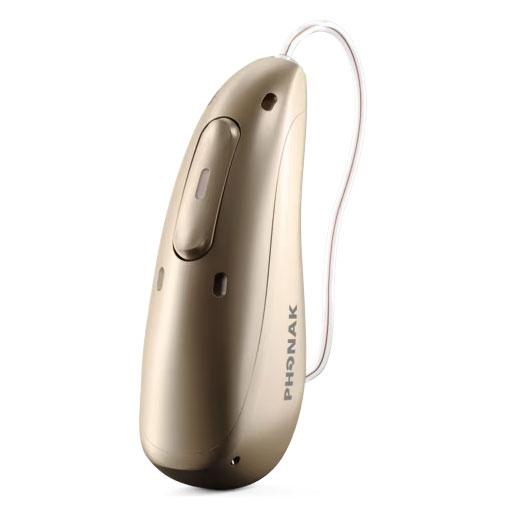
Phonak’s Infinio Sphere delivers genuinely standout speech clarity in loud, noisy places thanks to its DEEPSONIC “Sphere mode,” but you’ll trade some discretion and may wrestle with fit or Bluetooth pairing to get that top-tier performance.
Expert Review
That is the uncomfortable reality. A hearing aid can be technologically excellent and still not be the right fit for every person.
In some cases, clinicians may still choose an older or smaller device because the patient’s anatomy, dexterity, comfort needs, or preferences make the larger option impractical.
That does not make Sphere a bad product. It makes it a very advanced product with a very real design trade-off.
The next frontier: Shrinking the compromise
The encouraging part is that Phonak does not appear blind to these issues.
Anders Rosengren, Sonova’s Chief R&D Officer, spoke about a 5-to-7-year development pipeline focused heavily on energy management. That is exactly where the next big battle will be. If Phonak can make this level of processing more efficient, or pair it with better battery technology such as solid-state batteries, the same kind of speech-in-noise performance may eventually fit into smaller and more flexible designs.
That direction already shows up in the Ultra update. One of the original knocks on Sphere was battery life in the more demanding loud-noise mode. The Ultra rollout improved that practical limitation, with Phonak saying users can now stay in the intensive Sphere mode for about 10 to 11 hours, compared with around 7 hours before the update. For the most demanding users, that can mean the difference between a hearing aid that dies before the end of the day and one that lasts until bedtime.
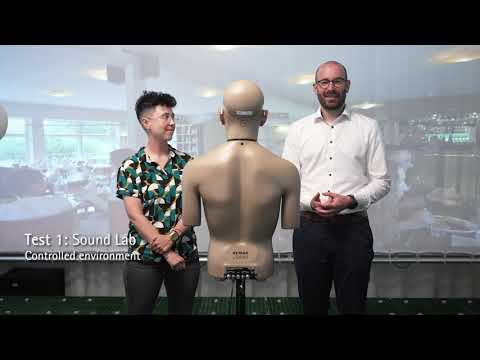
Michael Preuss is also pushing the engineering teams from a deeply personal place. He is asking for devices and accessories that survive real life, including sweat, moisture, and demanding use. His own experience with Swiss trail races has shaped his interest in better moisture protection for custom-molded earpieces, such as Phonak’s cShells, which are often used when patients need a more secure acoustic seal and more power than a standard rubber dome can provide.
This points out that some of the most meaningful improvements in hearing care come not from abstract engineering goals, but from the feedback of people who actually depend on the device every waking hour.
The takeaway for consumers
Phonak Sphere represents one of the clearest examples yet of where premium hearing aid technology is headed.
The future is not just better microphones. It is more powerful onboard processing. It is hearing aids that do more than amplify and steer sound. It is devices that attempt to separate speech from noise in a more intelligent, real-time way.
And in this case, the lab data support the direction of travel. Ultra Sphere earned a 4.58 out of 5 overall SoundScore in HearAdvisor’s standard testing, with especially strong results in the speech-in-noise situations this technology was built to address. Even more importantly for this story, its dedicated DNN-powered mode produced the strongest speech-in-noise performance HearAdvisor has measured to date in additional testing.
But consumers should understand the bargain: you may get a meaningful improvement in difficult listening situations, but for now, you may also have to accept a larger device, more dependence on battery capacity, and potential practical challenges if you need custom molds.
That is the fair version of the story. Sphere is not a tiny miracle device that makes every compromise disappear. It is a powerful new tool that pushes hearing aids beyond the limits of traditional directionality.
For the right person, especially someone who has spent years feeling cut off in noise, that trade-off may be more than worth it.
Just ask Michael Preuss.
For him, the breakthrough was not a spec sheet. It was a question from a flight attendant, heard from a seat away, at a moment when he never expected to hear it.
Abram Bailey, AuD
Founder and PresidentDr. Bailey is a leading expert on consumer technology in the audiology industry. He is a staunch advocate for patient-centered hearing care and audiological best practices, and welcomes any technological innovation that improves access to quality hearing outcomes. Dr. Bailey holds an Au.D. from Vanderbilt University Medical Center.